I am very much a Johnny-come-lately to Mystara. During the
time the originals were being released I had little use for Basic/Expert
D&D. My friends all played Advanced Dungeons and Dragons, not the “training
wheels version. I did get both “Keep on the Borderlands” (1980) and “the Isle
of Dread” (1981) because I purchased the boxed basic and expert sets (If you
are interested these two adventures, I highly recommend picking up the Goodman
games hardback re-releases which include the original adventures in their
entirety, as well as the history of their creation and a 5e conversion). I did
purchase all four Blackmoor adventures (1986-1987), but these are Mystara only
in the vaguest sense of the world being set thousands of years in the past before
content shifting cataclysm. However, I picked up very little of the other BECMI
adventures. There is a nice history of the origins of the Known World and how
it got grabbed for its first appearance in the BECMI set here.
I gave the Gazetteers a pass entirely. If you read my posts on Greyhawk and
Forgotten Realms you’ll realize that Gazetteers are not my favorite begin with
having little to steal for actual adventure encounters. I did pick up the
second edition conversion of Gliantri, however by that time TSR had thrown in
the towel on Mystara so there was little else to acquire. There my relation
with Mystara sat, until the 2000s. I had some interest in Living Blackmoor when
it resurfaced but my friends were hard over on Living Greyhawk so didn’t do
much with it. When I got into blogger I started following Harvards Blackmoor blog, which
since he is a big fan of Mystara led me to the Vaults of Pandius and Thorfin Taits Cartography. Being a sucker
for Cartography Thorfins work led me to try and hunt down some Gazetteers in print
(I had already downloaded the free one Wizards of the Coast posted on its
website). After picking three or four in print I realized the price to value
proposition was not good (having been first sold before people realized they
were cool they generally sold for twice their cover price, although the one I
grabbed at the library book sale for a couple bucks was a steal). When
DrivethruRPG put the complete set of Gazetteers as a bundle on sale I picked up
.pdfs of all of them. I still have to read through all fourteen. Vaults of Pandius has
another dozen or so Fan generated Gazetteers as well. There is also the whole Hollow Earth series which I have not delved into at all. My friends who liked surface Mystara disliked the Hollow World (Although Thorfin has made a really cool globe showing how the Hollow world and surface connect. I am still delving into
the wonders of Mystara so it is hard to compare and contrast with Forgotten Realms or Greyhawk. In general, Mystara seems of larger-scale dealing with empires, rather than the kingdoms
and free cities of the Forgotten Realms and Greyhawk. Looking at the maps it
seems more densely populated as well. Of course, I also enjoyed the brilliant
map by Chatdemon of Mystoearth which uses the Mystara map for the
lands west of Greyhawk. It also gives a good sense of scale between Greyhawk
and Mystaran Continents, Greyhawk being about a quarter the size (Further
research is required, as a quick perusal of Thorfins maps seems to show the
actual region covered by the Gazetteers as much less than the continents displayed, so
perhaps equivalent to Greyhawk after all). For those fond of Mash-ups, there is this crazy map which smashes together the Forgotten Realms, Mystara, Ebberon
and many other TSR worlds together in one map. My impressions of Mystara are as follows. The maps are well done. The Gazetteers are interesting covering a broad range of cultural tropes. In contrast to Forgotten Realms and Greyhawk, there seems to be less unexplored wilderness as most areas are under the control of some empire or kingdom. Some of the cultural juxtapositions are a bit jarring having ancient Rome next to medieval France. In terms of an overall ranking of my preferences, it is still going to come in behind Greyhawk and the Forgotten Realms as a setting.
Sunday, September 8, 2019
Monday, August 19, 2019
Forgotten Realms and Me

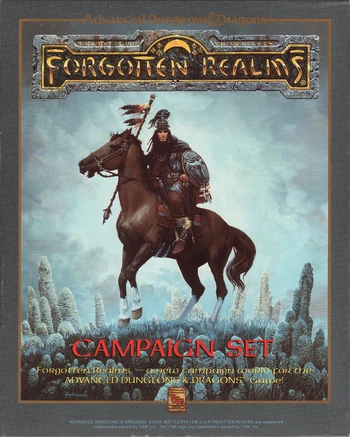
I bought the Forgotten Realms boxed set when it first came
out in 1987 and have been collecting the reference material ever since. I never
bothered with the novels much. Although everyone thinks of Ed Greenwood as the
creator, the first edition gazetteers were written by an ensemble cast of
authors. There are sixteen Forgotten Realms Sourcebooks. Less than a quarter of the sourcebooks list
Ed Greenwood as the main author. Other lead authors include Doug Niles, Steve
Perrin, Paul Jaquays, R Salavtore, Jean Rabe, Scott Haring, Scott Bennie,
Curtis Scott, Rick Swan and Tom Prusa.
I had little use for running the gazetteers as written since I was at the time mostly stealing ideas for my own campaign. I liked the
maps and enjoyed the little plastic hex overlay. The hardback still remains
the best source for City maps. Most of the good monsters, spells, and magic
items have moved to the mainstream long ago.
The Gold box computer games were also set in the Forgotten Realms
and explore the Moonsea region. There are a couple of print adventures that go
with the computer games. However what works well in computer games is kind of clunky
in print adventures and vice versa. After the first two computer games, there
were no more print adventures. I played these games a lot but never finished
any. My son is still using the Forgotten Realms Unlimited Adventure set (and
Dungeoncraft a more modern clone) to crank out more.
Actual adventures set in the Forgotten Realms were rather
sparse in the early years, although both the Oriental adventures and the
Bloodstone series were added via retroactive continuity later on. In 1987 the
only actual adventure (not counting Bloodstone and Oriental adventures) was “Under
Illefarn”. 1988 saw “Swords of the Iron Legion” and the “Ruins of Adventure” gold
box game tie in. 1989 saw the “Curse of Azure Bonds” gold box game tied in, as
well as the perfectly dreadful 1st to 2nd edition
transition adventures FRE1-3. Gods are slain continents laid waste, and what is
the players’ role? Bring the popcorn and watch the show.
The 90’s were a bit better. I liked the “Beneath the Twisted
Tower” adventure in the 1993 2nd edition of the Forgotten Realms
boxed set. I loved the Ruins of Undermountain and Myth Dranor boxed sets.
Menzoberandian was good but mostly City with less adventure (I am still dinking
around with the computer game but haven’t made it to the city yet). Ruins of
Zhentil Keep had some good adventures but confused me (since I haven’t kept up
with the novels). Why is ruined, how after having their entire City blown to
bits is the Zhentarium still functioning? The Zhentarium have to be the most
resilient organization in existence having their base of operations destroyed,
their patron god slain and yet they still exist to plague 5th
edition. I suppose the Beholders who run the Zhentarium just like the name.
I own a number of the 90’s softcovers (Dragons of the Realm,
Giants of the Realm, etc.)even though these are mostly splat book in nature.
Some B.S. history no one cares about, a few new spells, a few new magic items.
I also played the Eye of the Beholder computer games a lot.
The first two games although theoretically set in Forgotten Realms are self
contained dungeons requiring little forgotten realms lore. The first one given
its start in the sewers of Water deep should interpenetrate Undermountain, but
it doesn’t. The second teleports to some temple on in the middle of nowhere,
and the only thing Realms related is Khelben Blackstaff who gives you the
mission and shows up in a couple cut scenes. The third which is supposed to be
set in Myth Dranor is dreadful, and bears no resemblance to the boxed set of
the same name.
I have no idea where to classify Mazitca, Kara-Tur or Al
Qadim, as these seem as bolt-ons rather than core forgotten realms (of course
most of Forgotten realms is bolt-on to Ed Greenwoods Waterdeep and the
Dalelands). Mazitca did help inspire my own jungle river campaign, but other
than jungles and rivers there is not that much overlap.
I do own the Baldur’s gate and Ice Wind Dale series of
computer games, but never got very far. Baldur’s Gate does not seem to
understand how many Kobolds one must kill to reach second level, but has no
problem throwing four ogres at a first level party as a random encounter. In
Ice Wind Dale I explored the tombs in the wrong order, and never could get the
gate I needed to progress onwards to open again. The Neverwinter Nights computer
game seemed cool in concept, but I never got past the introductory adventure.
Third Edition Forgotten Realms is probably my least
favorite. Myth Dranor turned from a perfectly marvelous demon haunted ruin into
some twee elf city. I had to call shenanigans on returned Netheril’s shadow
magic which is just like regular magic, but somehow works in magic dead zones.
Serpent Kingdom has some interesting Yuan-Ti
lore even if it included the game breaking Sarrukh (leading to the
infamous Pun-Pun
Kobold of infinite strength build).
I played a lot of Living Forgotten Realms in fourth edition.
Some of the place here stuck reasonably well such as the Vikings of the
Moonshae, Demon haunted Impiltur, Aglaronds constant battle with Thay, and of
course Waterdeep. However, some of my favorites I believe have been penned out
of existence in the fifth edition retroactive continuity, including Returned
Abier and the Dragonborn Kingdom of Tymanther.
Myth Dranor being infested with Chaos fungus serves those elves right. The
Neverwinter meltdown that showed up at the end of the fourth edition, at least
changed the map of one City.
Most of the Fifth edition hardbacks so far have focused fairly
close to Waterdeep , and the Sword Coast. Prior adventures league seasons have
focused around the Moonsea. This season regions have been parceled to various
conventions (we’ll see if that was a good idea). However, I haven’t seen much
Forgotten Realms east of Mulmaster, or south of Amn (Chult excepted). Thay exists of course but
only as a constant supply of evil baddies. I haven’t seen much on Cormyr, or
the Dalelands important parts of the second edition realms.
Things I like most about Forgotten Realms Waterdeep,
Undermountain, the Underdark, the Great Glaicer
Things I like least, all those Novels, all the retroactive continuity,
and the way the timeline advances hundreds of years but nothing actually
changes.
Top ten Forgotten Realms items:
Undermountain boxed set
Dungeon of the Mad mage
Myth Dranor boxed set
Waterdeep and the North
Pool of Radiance Gold Box Computer game (the original)
Dreams of the Red Wizards
Mines of Bloodstone
The Bloodstone lands
Dragons of the Realms
The Great Glaicer
Tuesday, August 13, 2019
50 Shades of Vorpal review
Note on 50 sHAdes of VORpal. When I put my five bucks in the ring for this one it seemed like some seventeen olds wild ideas about how a game should be and was filled with strange and wondrous drawings from what seemed like a seventeen-year-old's school notebook. The stretch goals are a total hoot as well. There is an interview with the author during the campaign at this defunct blog save via Wayback Machine here Necropants
Interview Link, Although the delivered .pdf was very rough it was about what I expected (and deserved given my suggestion when it was running late of just slapping the notes on a scanner and sending them out). My wishful thinking self kept thinking that the designer was actually going to take another pass and fill in the blank pages, but got an update on July 20 officially declaring it "dun". Checking the comments page on Kickstarter it appears that $50 backers have been receiving three-ring binders with a print-out of the same pdf I got two years ago all this month. With an original delivery date of December 2015, it is less than four years late (better than many NASA projects I worked on). In my darker moods, I envisioned this Kickstarter ruining the life of some seventeen-year-old too naive to realize what they had signed on for, so I was glad to see that the author actually brought the Kickstarter to closure.
I decided to take a closer look and review it page by page, but this proved to mostly fruitless. I understand the theory of bad formatting as part of the joke, but the practicality is that it renders much of the book unreadable. I don't even know to format a .pdf so that it splits pictures (and text) in half between pages. The deliberate spelling error joke gets old after a while. The continuing running dialog between the author, artist, and editor is hilarious. Most of the book is class descriptions and pictures. The pictures are unpracticed but evocative. The class descriptions are uneven in quality and completeness, but the names spark the imagination. My favorite names include Lowlings and Quarter demi halflings. Fighting uses a d30 but there is not enough description to actually play. The weapons table has some potential including a coolness rating for each weapon. The Monster section is fairly short but does include "Breaker, game (like a tarrasque only tougher)" as well as both "unassuming" and "vorpal" bunnies. I was disappointed the 1d12 hydracorn was relegated to a footnote on the last page, and that the awesome illustration of the hydracorn from the Kickstarter updates was omitted. The location section follows next. My favorite location is the uber dark. As all "old school" gamebooks this one ends with a random assemblage of unfinished thoughts.
Did I get my five bucks worth? I was disappointed that he didn't take another pass at the text. With even a minimum effort the author could have matched the quality of the Arduin Grimoire or even the little brown books of Orginal Dungeons and Dragons. However, this perhaps was not the author's goal. For an old guy like me, something that reminds me of my high school friends is probably worth five bucks anyway.
Here are some other peoples thoughts on 50 Shades of Vorpal.
Tenker's Tavern Nonreview Link
and the Hydracorn

I decided to take a closer look and review it page by page, but this proved to mostly fruitless. I understand the theory of bad formatting as part of the joke, but the practicality is that it renders much of the book unreadable. I don't even know to format a .pdf so that it splits pictures (and text) in half between pages. The deliberate spelling error joke gets old after a while. The continuing running dialog between the author, artist, and editor is hilarious. Most of the book is class descriptions and pictures. The pictures are unpracticed but evocative. The class descriptions are uneven in quality and completeness, but the names spark the imagination. My favorite names include Lowlings and Quarter demi halflings. Fighting uses a d30 but there is not enough description to actually play. The weapons table has some potential including a coolness rating for each weapon. The Monster section is fairly short but does include "Breaker, game (like a tarrasque only tougher)" as well as both "unassuming" and "vorpal" bunnies. I was disappointed the 1d12 hydracorn was relegated to a footnote on the last page, and that the awesome illustration of the hydracorn from the Kickstarter updates was omitted. The location section follows next. My favorite location is the uber dark. As all "old school" gamebooks this one ends with a random assemblage of unfinished thoughts.
Did I get my five bucks worth? I was disappointed that he didn't take another pass at the text. With even a minimum effort the author could have matched the quality of the Arduin Grimoire or even the little brown books of Orginal Dungeons and Dragons. However, this perhaps was not the author's goal. For an old guy like me, something that reminds me of my high school friends is probably worth five bucks anyway.
Here are some other peoples thoughts on 50 Shades of Vorpal.
Tenker's Tavern Nonreview Link

Sunday, July 21, 2019
Kickstarter Update 2019
I received a note from Kickstarter citing me as a super backer of over 153 projects. I thought it was time I went through and checked on how they are doing, as I have been doing on an annual basis on this blog for several years. As always, I found one which should have been delivered but I missed the e-mail. A quick request for resending has once again resolved the issue. I remain amazed, considering the large number I support, only three are long overdue.
Projects I backed (note projects that I reported last year as complete have been removed from the list):
Not due yet
Fateforge: a 5th Edition
Roleplaying Game
The King of Dungeons
Dungeons & Delvers: Red Book
Fantastic Adventures: Ruins of the
Grendleroot for 5e
Hearts of Wulin
Trilemma Adventures Compendium
Empire of the Ghouls: A 5th Edition
Campaign vs. the Undead
The Koryo Hall of Adventures 5e
Compatible Campaign Setting
Sea King's Malice: a 5E Adventure
in the Deadly Depths
The Grande Temple of Jing V1 - For
5th Edition (and others)
Lancer
The Folio #22 (1E/5E D&D
Adventure)
Symbar - Mother of Darkness
Critical Core
Terrain Essentials
GODS - The dark fantasy RPG
Ruin Masters
The Isle of The Amazons - RPG Zine
for #ZineQuest
The Tomb of Black Sand
The City of Great Lunden
Arcana of the Ancients, a 5E science-fantasy
sourcebook
Rise of the Drow: Collector's
Edition for D&D 5E or PFRPG
Adventures Great and Glorious
The World of the Lost Lands
Metal Gods of Ur-Hadad Zine
Returns!
The Ultraviolet Grasslands
A Rasp of Sand: A Roguelike
Tabletop RPG Experience
Reach of Titan
Mini-Dungeon Monthly: RPG zine for
D&D 5th Edition
Monsters & Magic: a 5e bestiary
and treasury
Treacherous Traps for 5th Edition!
The ADOM (Ancient Domains Of
Mystery) Roleplaying Game
Cha'alt
Lost Hall of Tyr (2nd Edition):
Maps and Print Run
Greg Stolze's Reign, Second Edition
Your Best Game Ever!
CAVALIERS OF MARS
A bit late
Tegel Manor Returns! Estimated
delivery Jun 2019
EMBERWIND: a new breed of tabletop
RPG Estimated delivery Jun 2019
Castles & Crusades: Den of
Iniquity Estimated delivery Jun
2019
Demon City: The Ultimate Horror RPG Estimated delivery Jun 2019
Secrets of the Nethercity Estimated delivery Jun 2019
Dungeons of Amara: Poems and Art of
Monsters and Townfolks Estimated
delivery May 2019
SECRETS of BLACKMOOR: The True
History of Dungeons & Dragons Estimated
delivery Mar 2019
Rise of the Demigods Estimated delivery Mar 2019
Complete
John Carter of Mars - The
Roleplaying Game
The Vagabond’s Cyclopedia: an OSR +
PbtA Supplement
Desert Dwellers Estimated
Humblewood Campaign Setting for 5e
DND
Silent Titans Estimated delivery
Rex Draconis RPG - Rising Tides
Vagabonds of Dyfed RPG: OSR meets
PbtA
The Midderlands Expanded - An OSR
Setting Expansion
The Bane of Roslof Keep high level
1E & 5E gaming adventure
Trudvang Chronicles - Stormlands
Calidar "On Wings of
Darkness"
Esoterica Tabletop Roleplaying Game
Sandy Petersen's Cthulhu Mythos for
5e
Dortoka: an OSR + PbtA City Module
Folio of Fiendish Monsters 1E
monster compendium
Occult Secrets of the Underworld
The Complete White Ship Campaign
1E&5E mega-adventure
Make/100! Spell: The RPG &
Spellbook Engraved Wood Box Set
YNDAROS: THE DARKEST STAR, award-winning
Symbaroum campaign
Over the Edge: A Roleplaying Game
of Weird Urban Danger
The Curse of Roslof Keep high level
1E & 5E gaming adventure
Confrontation – Classic The
legendary skirmish game (note I just gave them a buck to read their updates)
The Dragon Heresy Introductory Set
Fantasy RPG (5E-variant)
Rappan Athuk: Reborn for Fifth
Edition! Go down the Well!
Tome of Horrors: Reborn for Fifth
Edition
SYMBAROUM - Monster Codex
Forbidden Lands - Retro Open-World
Survival Fantasy RPG
The Folio #16 & #17 Double 1E
& 5E Adventure Set
The Folio #18 & #19, 1E &
5E Adventures
Lost Hall of Tyr: A 5e Adventure
(Dungeon Grappling support)
Luminous Echo: The Forgotten King
extended campaign
Spire RPG
Artifices of Quartztoil Tower - 5E
Adventure
Capharnaum - The Roleplaying Game
Sommerlund City Maps
Midgard Campaign Setting: Dark
Roads & Deep Magic
Luminous Echo: The Forgotten King
extended campaign
Salt in the Wounds
Slumbering Ursine Dunes
Heroic Fantasy & Barbarian
Conquerors Collection
50 sHAdes of VORpal (Officially declared "dun" 7/20/2019)*
Neverending Story
Ryuutama (basically done but pledge
contains permanent electronic updates)
Pieces missing
Rhune (one adventure short)
Please come home, I still love you baby (way past due, but I still want the item).
Marmoreal Tomb (Tons of beautiful
maps are done, but no adventure yet)
Throne of night
*Note on 50 sHAdes of VORpal. When I put my five bucks in the ring for this one it seemed like some fifteen olds wild ideas about how a game should be and was filled with strange and wondrous drawings from what seemed like a fifteen-year-old's school notebook. Although the delivered .pdf was very rough it was about what I expected (and deserved given my suggestion when it was running late of just slapping the notes on a scanner and sending them out).
Friday, June 28, 2019
Greyhawk and me
I have been meditating on fantasy campaign settings and why there are distinct preferences for one over another. Some such as Dark Sun and Tekumel are unique. However many of them seem quite generic including Greyhawk, Forgotten Realms, Mystara, Golarion, and Kobold presses Midgard. These start with a Medieval Western European base zone and tack on other cultural memes such as Viking, Arabian, and Asian cultures. Golarion and Midgard I understand, as third-party products they need a setting they can control. However, the three-way fight between Forgotten Realms, Greyhawk and Mystara, seems hard to comprehend. All of these are sufficient breadth and scope to allow a DM to insert whatever adventure they care to run. I am not an expert on any of these worlds, but they seem very similar when contrasted with Dark Sun. Greyhawk being the oldest perhaps should take the primacy of place. However, most of my recent experience has been with Forgotten Realms. As a start to analysis, I will in this post discuss my experience with Greyhawk.
I first encountered Greyhawk in the Greyhawk expansion to the little brown books in 1975. Although there were several pages of short adventure suggestions there was very little setting. I played "Descent into the Depths" as a tournament module at GenCon, but the Underdark has little relation to the surface kingdoms of Greyhawk. The next year was "Secret of the Slavers Stockade" with some actual information about the Pomarj. In 1980 came the famous Darlene Map and Gazetteer, however, a list of place names and dry facts is not something that captured my imagination. Also in 1980 I picked up and DMed the "Village of Homelet" which was going to be a campaign but fell apart after the moat house was cleared and the promised sequel the "Temple of Elemental Evil" failed to appear. By the time "Temple of Elemental Evil" came out I had moved on in my life. Rumor has it that Forgotten Realms was much more popular with the writing staff at TSR during the Gygax era because Greyhawk material required Gary's approval.
I followed the 2e restart, but the Greyhawk war never quite resonated with me. "Border Watch" is a nice beginner module. "Iuz the Evil" is a great explanation of Iuz evil empire. "Vecna lives" is a marvelous high-level adventure, but is set in the Sea of Dust far from the main centers of action. The "City of Greyhawk" boxed set was interesting especially the side quest cards (a feature which has disappeared from modern design) however I disliked the main city map (better Greyhawk city maps are available on the web). The disappointment of the various "Castle Greyhawk" iterations is a whole blog post in itself.
3e saw the rise of "Living Greyhawk". I was a bit late to the party starting in 2006. Living Greyhawk brought a great breath to the world, but everything was highly compartmentalized by real-world geographical region. In Ohio, I was restricted to Veluna. Getting actual Veluna modules were a bit hit and miss, requiring the third party volunteer coordinator to e-mail both the encrypted module and password key. However, in our group, I used the special adventures set in the "Bright Desert" (for Wizards of the Coast [WoTC] modules you could download them off the web site, and only have to request the password). Unfortunately, the intellectual property for most of the "Living Greyhawk" modules is a total mess with module rights reverting to the author, but Greyhawk content being retained by WoTC rendering everything unpublishable without removing the content of most interest to me. "Expedition to Castle Greyhawk" was the last flurry of 3e. I thought the book was well written for the most part, but I was annoyed that the upper levels were expected to be randomly generated. I did pick up some "Living Greyhawk" modules for the upper levels which I ran my nephews through (pretty good low-level dungeon crawls, but probably also lost in the IP meltdown).
4e cleared Greyhawk from the table. With 5e we are beginning to start to see a return with: the Greyhawk pantheon included in the player's guide; several classic Greyhawk adventures like "White Plume Mountain", "Tomb of Horrors", "Against the Giants", and the "Hidden Shrine of Tachoman" updated; and the "Ghosts of Saltmarch" being officially set in Greyhawk. I have not played any of the new material yet so cannot say how well they play. Most of these so far seem to be drop-in adventures having very little to do with lore from the larger Greyhawk world. I also love the gorgeous map of Greyhawk made by Anna Meyer.
So where does this leave me and Greyhawk? I think modern play owes a great debt to Greyhawk marking both Mystara and Forgotten Realms as derivative products. However, the on-again-off-again publication record makes it less comprehensive setting than Forgotten Realms. The written works of Mystara cover a much broader range of cultural memes than the published Greyhawk work. Although the Advanced Dungeons and Dragons hardcover book "Oriental Adventures" putatively placed Kara-Tur on the same planet as Greyhawk, Forgotten Realms very quickly absconded with it. I saw on the web a proposed conversion of Greyhawk to a points-of-light style setting which I found weird because to my way of thinking Greyhawk was always a points-of-light setting, to begin with. As I usually run my campaigns in one-horse towns seeming far removed from the central action of any campaign world (although in such places great evil festers and grows) any generic medieval western setting will do. Perhaps I am still running a disguised version of my Village of Homelet campaign after all (although no hidden 10th level assassins for me, please).
I first encountered Greyhawk in the Greyhawk expansion to the little brown books in 1975. Although there were several pages of short adventure suggestions there was very little setting. I played "Descent into the Depths" as a tournament module at GenCon, but the Underdark has little relation to the surface kingdoms of Greyhawk. The next year was "Secret of the Slavers Stockade" with some actual information about the Pomarj. In 1980 came the famous Darlene Map and Gazetteer, however, a list of place names and dry facts is not something that captured my imagination. Also in 1980 I picked up and DMed the "Village of Homelet" which was going to be a campaign but fell apart after the moat house was cleared and the promised sequel the "Temple of Elemental Evil" failed to appear. By the time "Temple of Elemental Evil" came out I had moved on in my life. Rumor has it that Forgotten Realms was much more popular with the writing staff at TSR during the Gygax era because Greyhawk material required Gary's approval.
I followed the 2e restart, but the Greyhawk war never quite resonated with me. "Border Watch" is a nice beginner module. "Iuz the Evil" is a great explanation of Iuz evil empire. "Vecna lives" is a marvelous high-level adventure, but is set in the Sea of Dust far from the main centers of action. The "City of Greyhawk" boxed set was interesting especially the side quest cards (a feature which has disappeared from modern design) however I disliked the main city map (better Greyhawk city maps are available on the web). The disappointment of the various "Castle Greyhawk" iterations is a whole blog post in itself.
3e saw the rise of "Living Greyhawk". I was a bit late to the party starting in 2006. Living Greyhawk brought a great breath to the world, but everything was highly compartmentalized by real-world geographical region. In Ohio, I was restricted to Veluna. Getting actual Veluna modules were a bit hit and miss, requiring the third party volunteer coordinator to e-mail both the encrypted module and password key. However, in our group, I used the special adventures set in the "Bright Desert" (for Wizards of the Coast [WoTC] modules you could download them off the web site, and only have to request the password). Unfortunately, the intellectual property for most of the "Living Greyhawk" modules is a total mess with module rights reverting to the author, but Greyhawk content being retained by WoTC rendering everything unpublishable without removing the content of most interest to me. "Expedition to Castle Greyhawk" was the last flurry of 3e. I thought the book was well written for the most part, but I was annoyed that the upper levels were expected to be randomly generated. I did pick up some "Living Greyhawk" modules for the upper levels which I ran my nephews through (pretty good low-level dungeon crawls, but probably also lost in the IP meltdown).
4e cleared Greyhawk from the table. With 5e we are beginning to start to see a return with: the Greyhawk pantheon included in the player's guide; several classic Greyhawk adventures like "White Plume Mountain", "Tomb of Horrors", "Against the Giants", and the "Hidden Shrine of Tachoman" updated; and the "Ghosts of Saltmarch" being officially set in Greyhawk. I have not played any of the new material yet so cannot say how well they play. Most of these so far seem to be drop-in adventures having very little to do with lore from the larger Greyhawk world. I also love the gorgeous map of Greyhawk made by Anna Meyer.
So where does this leave me and Greyhawk? I think modern play owes a great debt to Greyhawk marking both Mystara and Forgotten Realms as derivative products. However, the on-again-off-again publication record makes it less comprehensive setting than Forgotten Realms. The written works of Mystara cover a much broader range of cultural memes than the published Greyhawk work. Although the Advanced Dungeons and Dragons hardcover book "Oriental Adventures" putatively placed Kara-Tur on the same planet as Greyhawk, Forgotten Realms very quickly absconded with it. I saw on the web a proposed conversion of Greyhawk to a points-of-light style setting which I found weird because to my way of thinking Greyhawk was always a points-of-light setting, to begin with. As I usually run my campaigns in one-horse towns seeming far removed from the central action of any campaign world (although in such places great evil festers and grows) any generic medieval western setting will do. Perhaps I am still running a disguised version of my Village of Homelet campaign after all (although no hidden 10th level assassins for me, please).
Saturday, March 23, 2019
Garycon report
Hitched a ride with a couple of friends from the grognards podcast up to Garycon Last week. We ended up off-site at one of the myriad one-star motels that surround Lake Geneva. Unlike my friends who packed their schedules from 8 AM to Midnight. I tried to only sign up for a couple of things a day. Thursday morning was spent in the dealer's room, the afternoon going through the Garycon adventurers league first tier two adventure, and the evening listening to Larry Elmore pontificate. Friday I flew with the dawn patrol in Fight in the skies (Its a good system, but I hate flying allied planes in 1916) picked up the second Garycon adventurers league tier two adventure, sat in on the Greyhawk fan panel, and searched for the Source of the Nile. Saturday saw the third and final Garycon adventurers league tier two adventure, an Empire of the Petal Throne Dungeon boardgame variant (don't be picked up by the pale legion, you'll regret it), and watched D&D cartoons with Ernie Gygax in the evening. Sunday saw a trip through the Jakallan Underworld hosted by the head of the Tekumel foundation Victor Raymond. Because I had not booked my schedule full I was able to play in pick-up games of Index Card RPG and Ragnarok, watch people rolling up random treasure for First edition D&D (so much more exciting than treasure points) and chat with numerous folk (including Matt Finch and Anna Meyer) throughout the convention. Good times. However, I could have done with a bit more sleep than my gung-ho companions' schedules and our off-site location allowed.
Swag included:
Goodman Games:
- Into to the Borderlands (hardback)
- Isle of the Dread (hardback)
Kobold Games:
- Tome of Monsters (hardback; had the pdf already but find print more useful for Monster Books)
- Creature Codex (hardback)
Black Blade Press:
- Dark Druids (have picked up most of Rob Kuntz's modules in prior years, but "Dark Druids" was sold-out)
Swag included:
Goodman Games:
- Into to the Borderlands (hardback)
- Isle of the Dread (hardback)
Kobold Games:
- Tome of Monsters (hardback; had the pdf already but find print more useful for Monster Books)
- Creature Codex (hardback)
Black Blade Press:
- Dark Druids (have picked up most of Rob Kuntz's modules in prior years, but "Dark Druids" was sold-out)
Friday, February 8, 2019
Rulenomicon the Reviewing
Started a few months ago to go through my Role Playing Game (RPG) collection and give a stars rating to each of the items listed on my Rulenomicon page. I just finished up with Zweihander, the last game on the list, today. Here is a guide to what I mean by each star
blank - Not rated yet
* - Not playing this one
** - Might play this one if someone else is GMing and I have nothing else to do
*** - Interested in playing. GMing, or stealing ideas for my game
**** - Will be studying this one again and actively trying to convince others to play
***** - RPG perfection I am dropping everything to switch to this (no games rated this yet)
My star ratings are based on a quick flip through of the games which are mostly pdf files on my hard drive. They are somewhat capricious based on my initial impressions. I wanted to focus this list on RPGs so I have not rated items that turned out to be board games, miniature games, card games, campaign settings, or anything else other than an RPG (I may remove these from the list in the future). I guarantee I have called someone's RPG baby ugly. However, I do have some specific things I am looking for. Overall I am interested in systems that generate characters quickly, have rules that are simple to learn, but have enough complexity to make the game interesting in the long haul. I am more interested in campaigns than one shot adventures so character advancement is important. "Fifth edition Dungeons and Dragons (5e)" is my current go-to game, so an important consideration for any game is what does it do better than 5e. Since this is a review of rules I focused my attention on character creation, combat resolution, and spell casting. Rule sets vary in size from 1-page microgames to 400+ page tomes. Most of the games under 10 pages lacked enough complexity to sustain a long-term campaign and keep it interesting, so were rated lower. The 400+ page ones were treated more leniently as long I could find a core 20-30 page rules section which spelled out the base rules (a good table of contents helped with this immensely). The ability of the rules writer to explain things clearly and concisely without excessive use of acronyms and jargon was important. I have a great deal trouble with so-called "story games" as many of these reduce the resolution to a single dice roll, and also expect character reactions to be determined by dice rolls as well. One of the things I enjoy most about roleplaying is people working together to cooperatively solve problems, so games emphasizing intraparty conflict did not fair well in my ratings. I am biased towards fantasy settings, so modern and post-apocalyptic settings got rated a little lower (steampunk and hard sci-fi probably are somewhere in-between).
I definitely have an opinion on which dice rolling mechanics are best. D20 is my favorite as the probabilities are easy to calculate and one can add a significant number of modifiers without skewing the rolls to badly. D100 is next although since most of the games I see are doing things in 5% increments so they would better just using a d20. 2D6 can work but probabilities here are no longer linear and adds greater than +3 seriously skew the results. A number of games are dice pool based, calculating probabilities for these games is a serious challenge which make them not my favorite. Dice pool games where all but the top few dice are ignored have some possibility. Dice pool games which count the number of successes by the number of dice exceeding a certain number seem workable as well, but don't try to sell me custom dice with plusses and minuses, or funny symbols. Rolling dice pools and adding them together seems the road to disaster as the chance to beat 1d6 with 2d6 is less than 10% adding more dice just makes it more likely you'll roll closer to average with each and decrease these odds. Some systems which limit the range from 2d6 to 4d6 with the assumption that the two dice roller is a novice who is going to probably fail and four dice roller is a master who is going to succeed are barely tolerable. Once you start throwing in extra dice when high numbers are rolled, low numbers canceling out high numbers, and different color dice doing different things calculating probabilities becomes challenging in the extreme, but it probably only slightly shifts the one die versus two dice inequality.
P.S. Blogger refused to accept my MSword formatted table, so you'll have to accept a text based layout for now.
blank - Not rated yet
* - Not playing this one
** - Might play this one if someone else is GMing and I have nothing else to do
*** - Interested in playing. GMing, or stealing ideas for my game
**** - Will be studying this one again and actively trying to convince others to play
***** - RPG perfection I am dropping everything to switch to this (no games rated this yet)
My star ratings are based on a quick flip through of the games which are mostly pdf files on my hard drive. They are somewhat capricious based on my initial impressions. I wanted to focus this list on RPGs so I have not rated items that turned out to be board games, miniature games, card games, campaign settings, or anything else other than an RPG (I may remove these from the list in the future). I guarantee I have called someone's RPG baby ugly. However, I do have some specific things I am looking for. Overall I am interested in systems that generate characters quickly, have rules that are simple to learn, but have enough complexity to make the game interesting in the long haul. I am more interested in campaigns than one shot adventures so character advancement is important. "Fifth edition Dungeons and Dragons (5e)" is my current go-to game, so an important consideration for any game is what does it do better than 5e. Since this is a review of rules I focused my attention on character creation, combat resolution, and spell casting. Rule sets vary in size from 1-page microgames to 400+ page tomes. Most of the games under 10 pages lacked enough complexity to sustain a long-term campaign and keep it interesting, so were rated lower. The 400+ page ones were treated more leniently as long I could find a core 20-30 page rules section which spelled out the base rules (a good table of contents helped with this immensely). The ability of the rules writer to explain things clearly and concisely without excessive use of acronyms and jargon was important. I have a great deal trouble with so-called "story games" as many of these reduce the resolution to a single dice roll, and also expect character reactions to be determined by dice rolls as well. One of the things I enjoy most about roleplaying is people working together to cooperatively solve problems, so games emphasizing intraparty conflict did not fair well in my ratings. I am biased towards fantasy settings, so modern and post-apocalyptic settings got rated a little lower (steampunk and hard sci-fi probably are somewhere in-between).
I definitely have an opinion on which dice rolling mechanics are best. D20 is my favorite as the probabilities are easy to calculate and one can add a significant number of modifiers without skewing the rolls to badly. D100 is next although since most of the games I see are doing things in 5% increments so they would better just using a d20. 2D6 can work but probabilities here are no longer linear and adds greater than +3 seriously skew the results. A number of games are dice pool based, calculating probabilities for these games is a serious challenge which make them not my favorite. Dice pool games where all but the top few dice are ignored have some possibility. Dice pool games which count the number of successes by the number of dice exceeding a certain number seem workable as well, but don't try to sell me custom dice with plusses and minuses, or funny symbols. Rolling dice pools and adding them together seems the road to disaster as the chance to beat 1d6 with 2d6 is less than 10% adding more dice just makes it more likely you'll roll closer to average with each and decrease these odds. Some systems which limit the range from 2d6 to 4d6 with the assumption that the two dice roller is a novice who is going to probably fail and four dice roller is a master who is going to succeed are barely tolerable. Once you start throwing in extra dice when high numbers are rolled, low numbers canceling out high numbers, and different color dice doing different things calculating probabilities becomes challenging in the extreme, but it probably only slightly shifts the one die versus two dice inequality.
P.S. Blogger refused to accept my MSword formatted table, so you'll have to accept a text based layout for now.
Subscribe to:
Posts (Atom)